

Named a 2026 PR News Person of the Year: Why Billion-Dollar Brands Hire a Boutique Digital PR Agency
Rick Pendrick is a 2026 PR News Person of the Year. See why Genworth, Gaia and other billion-dollar brands now hire Prism, a boutique digital…
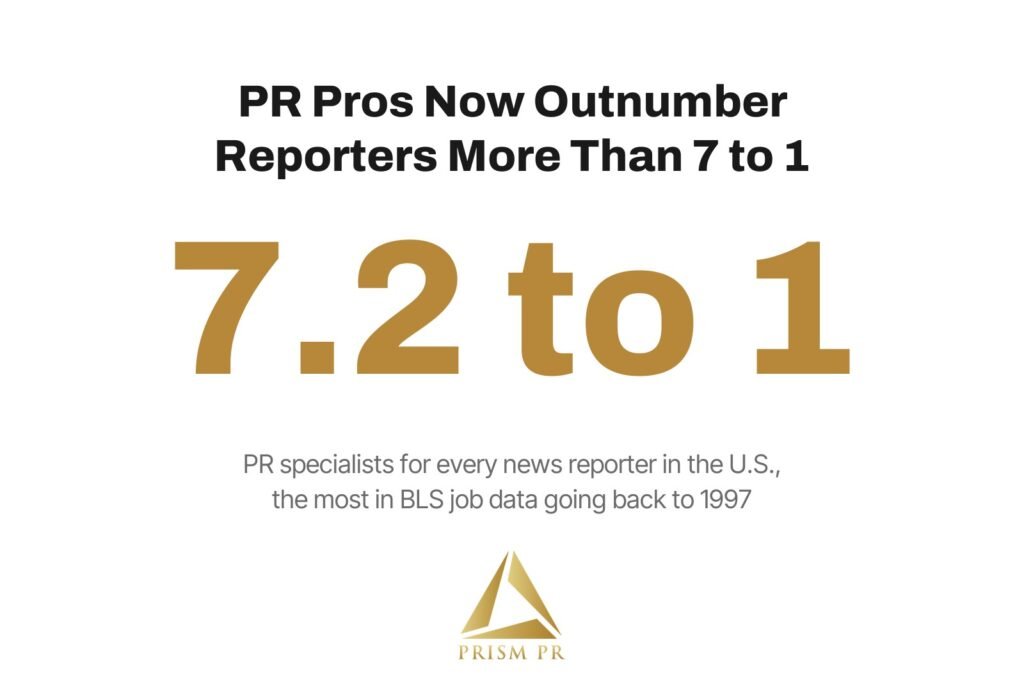
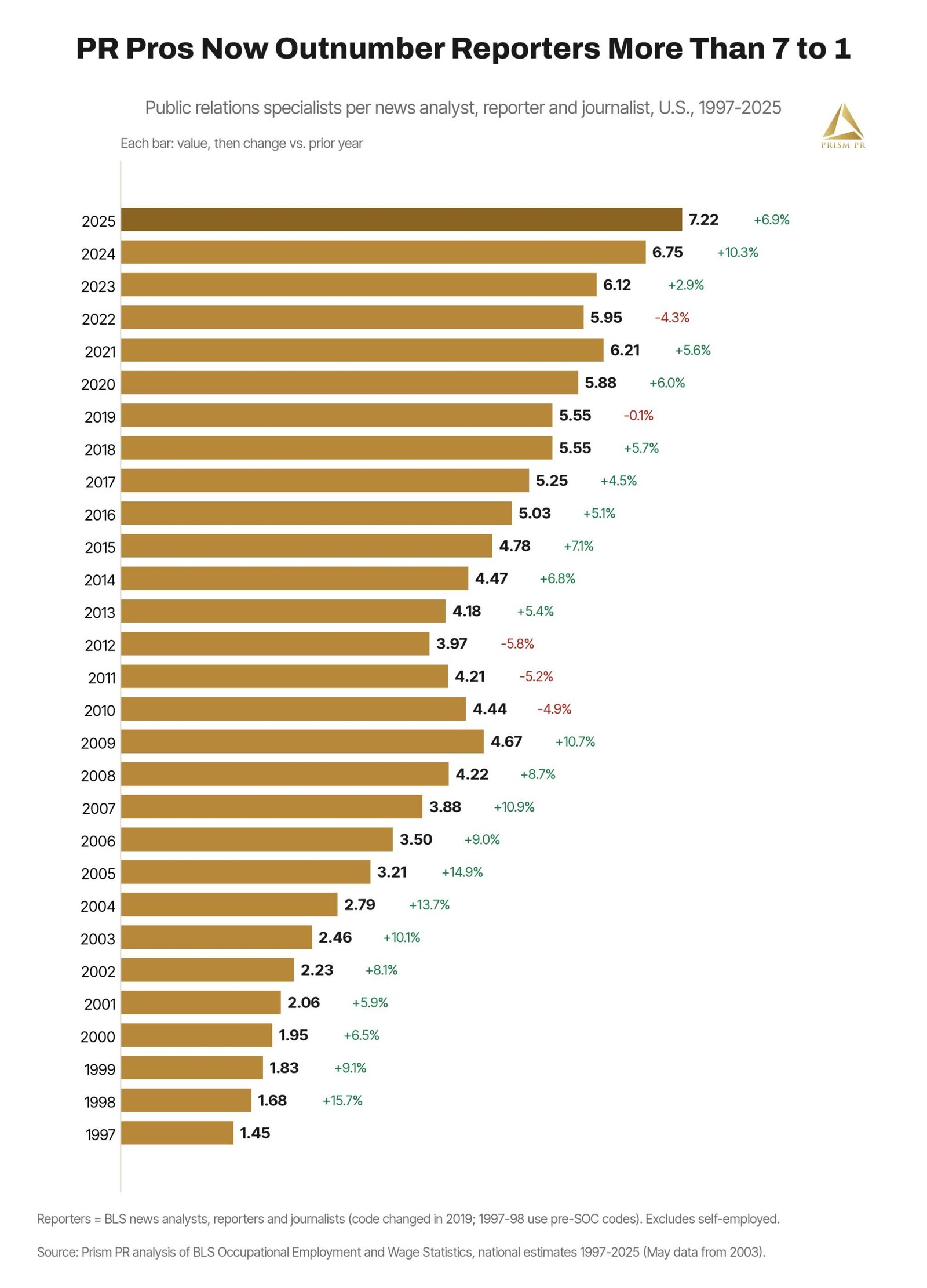
There are now 7.2 public relations specialists for every news reporter in the United States, the widest gap in Bureau of Labor Statistics job data going back to 1997. In 1997, the ratio was 1.45 to 1.
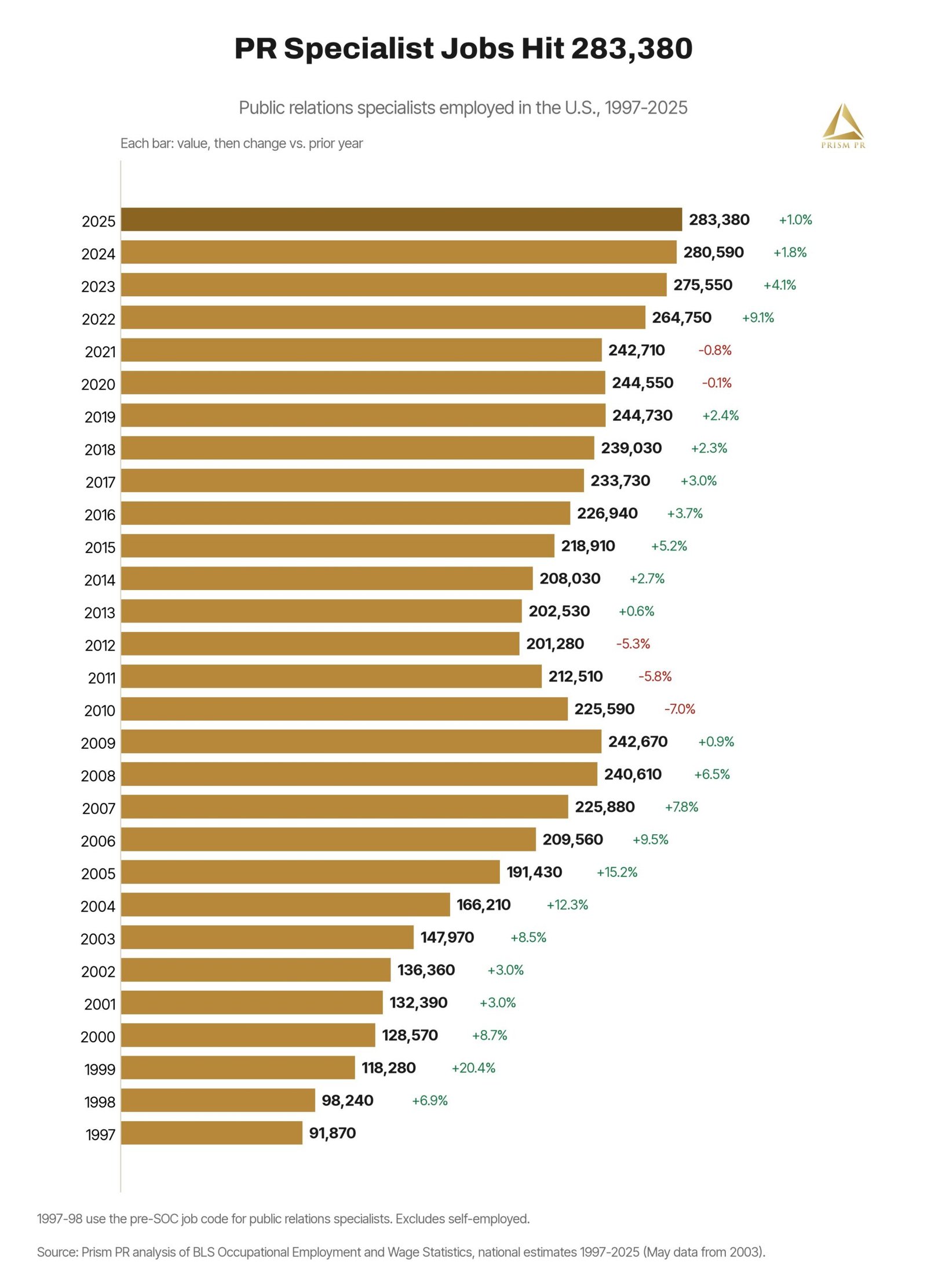
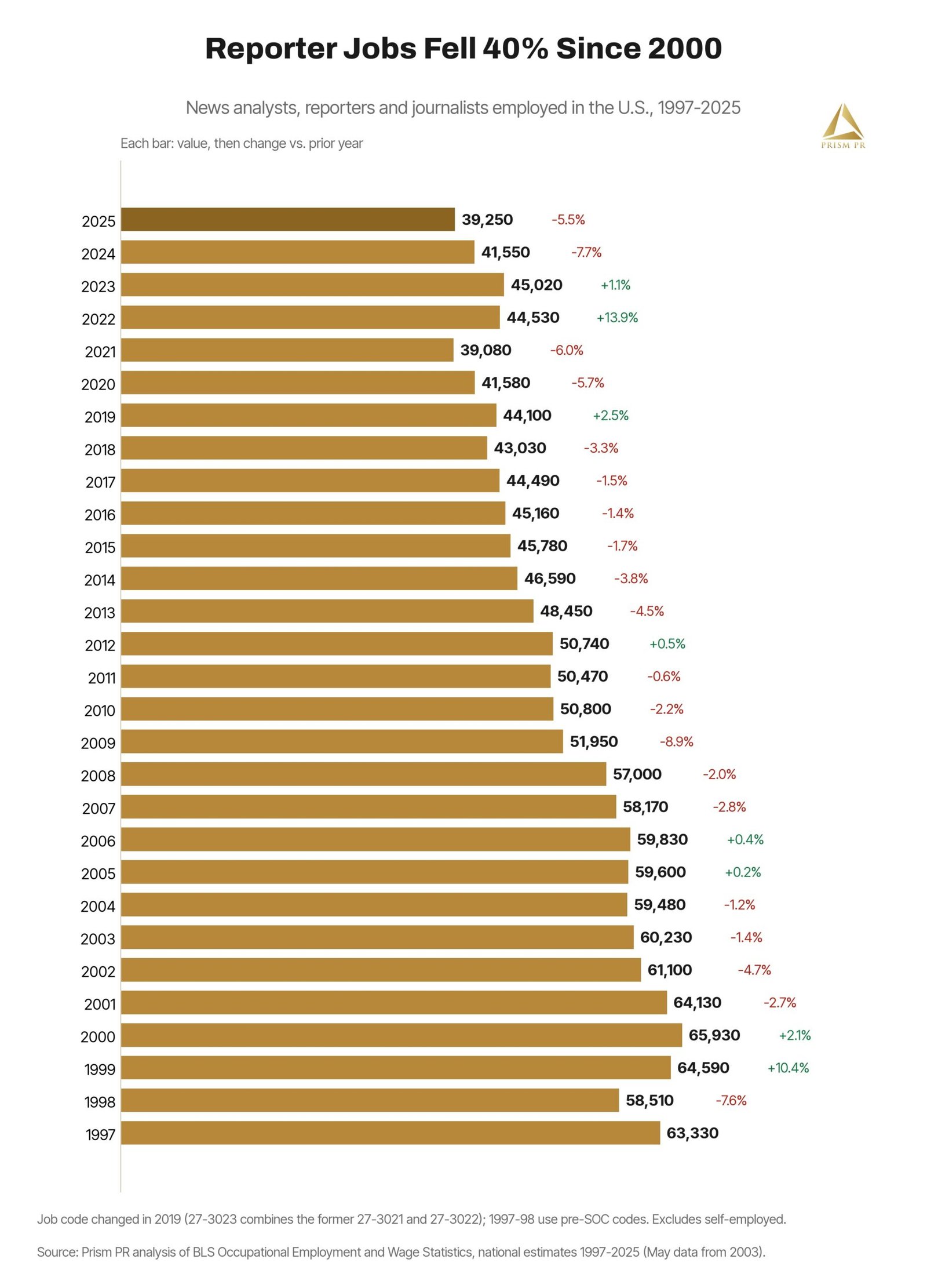
The U.S. employed 283,380 PR specialists in May 2025, the highest BLS estimate going back to 1997, and 39,250 news analysts, reporters and journalists, down 2,300 (5.5%) in a year. Since 2000, the peak year for reporter jobs in BLS data, PR specialist jobs have grown 120% while reporter jobs have fallen 40%, a loss of 26,680 reporting jobs. BLS has revised these job codes over the years, so the long-run comparison is a broad trend, not an exact count.
Local news is shrinking, too. 170 newspapers closed or merged in the past year, and 238 U.S. counties are now news deserts with no locally based source of professional news, up 26 in a year, the largest single-year increase in Medill’s research, according to Northwestern University’s State of Local News 2026 report. In more than 1,400 other counties, only one local news source remains.
The ratio counts jobs, not pitches, and not every PR specialist pitches reporters. The typical PR specialist earns $74,750 a year, $12,550 (20%) more than the typical reporter’s $62,200.
Prism PR, an award-winning, full-service PR agency that is also a digital PR and linkbuilding firm, set out to measure where PR specialists most outnumber reporters. We analyzed the newest federal job data for all 50 states and Washington, D.C., ranking every state by how many PR specialists it employs for each reporter, then added reporter pay, reporters per resident and the latest count of news deserts.
Here’s what we found.
PR Pros Outnumber Reporters More Than 7 to 1: There are 7.22 PR specialists for every reporter nationally, up from 6.75 a year earlier and the highest in BLS data going back to 1997. The ratio is nearly five times the 1.45 recorded in 1997 under older BLS job codes.
Minnesota Has the Most PR Pros per Reporter: Minnesota has 16.2 PR specialists for every reporter (8,260 PR specialists and 510 reporters), the highest ratio in the May 2025 estimates. Its reporter count carries a wide margin of error (a relative standard error of 17.0%), but Minnesota also placed No. 2 in our ranking of BLS’s 2023 and 2024 state estimates. Hawaii, Vermont, Delaware, New Hampshire and Colorado also top 12 to 1.
South Dakota Is the Only State Near Parity: South Dakota has 210 PR specialists and 190 reporters, a ratio of 1.1 to 1, followed by West Virginia (1.8) and Mississippi (3.1).
No State Has More Reporters Than PR Pros: PR specialists outnumber reporters in all 50 states and Washington, D.C.
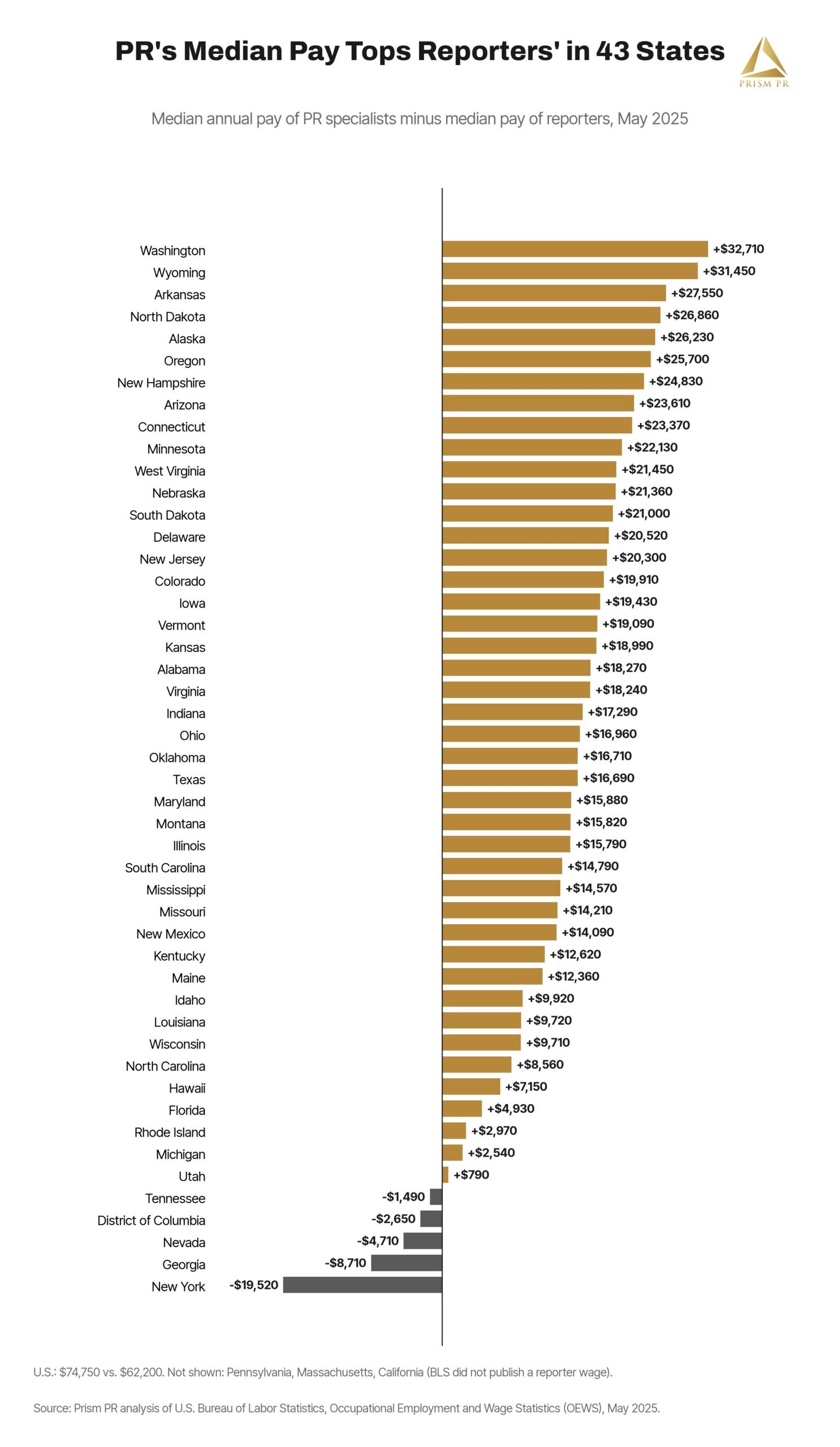
PR’s Median Pay Tops Reporters’ in 43 States: The BLS median wage for PR specialists is higher than the reporter median in 43 states. Reporters earn more only in Washington, D.C., Georgia, Nevada, New York and Tennessee. (BLS did not publish reporter pay for Pennsylvania, Massachusetts and California.)
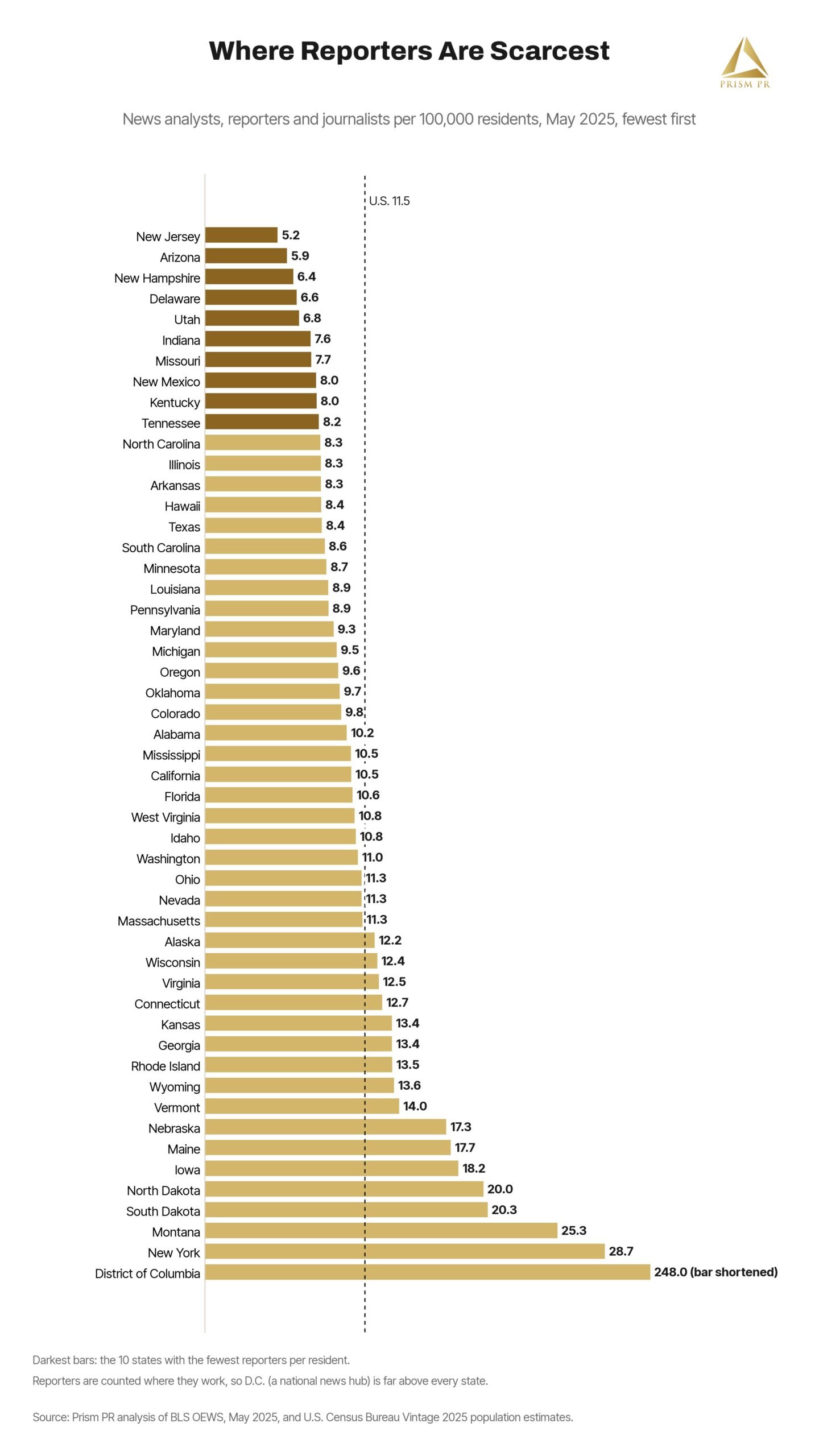
New Jersey Has the Fewest Reporters per Resident: New Jersey has 5.2 reporters for every 100,000 residents, the fewest in the nation and less than half the U.S. rate of 11.5. The estimate has a wide margin of error (relative standard error of 18.2%), and BLS counts reporters where they work, so journalists in New York and Philadelphia newsrooms who cover New Jersey are counted in those states.
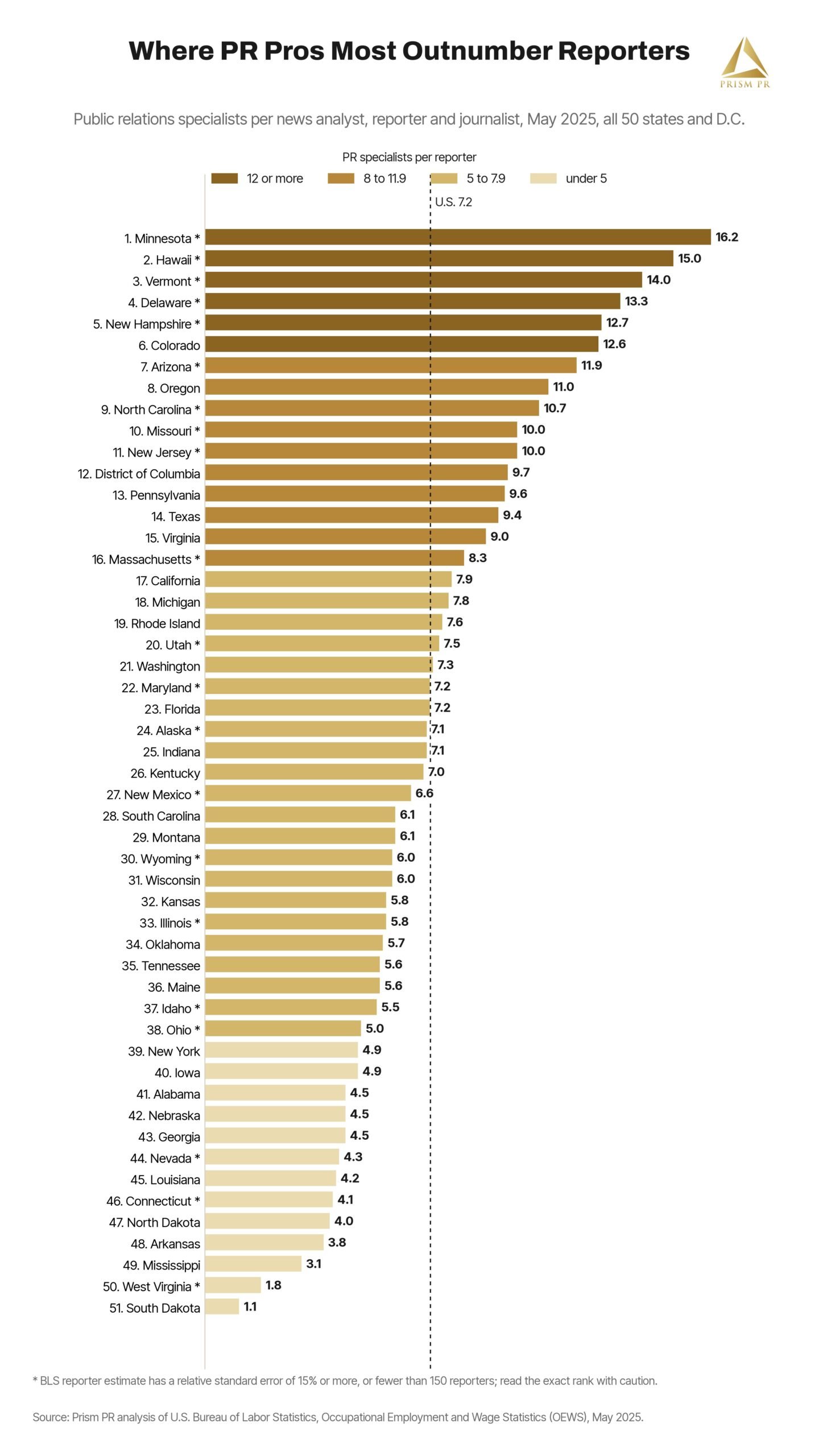
Minnesota, Hawaii, Vermont, Delaware, New Hampshire and Colorado each have more than 12 PR specialists for every reporter in the May 2025 estimates. Minnesota leads with 16.2, followed by Hawaii (15.0), Vermont (14.0), Delaware (13.3), New Hampshire (12.7) and Colorado (12.6).
Several have very few reporters: BLS counts 90 in Vermont, 90 in New Hampshire, 70 in Delaware and 120 in Hawaii. So the order within this group is not certain, but all six are well above the national ratio. Minnesota also placed No. 2 in our ranking of the 2023 and 2024 estimates, which under BLS’s method share part of their survey sample with 2025.
The next group, with 8 to 11.9 PR specialists per reporter, includes Arizona, Oregon, North Carolina, Missouri, New Jersey, Washington, D.C., Pennsylvania, Texas, Virginia and Massachusetts. Reporter estimates for Arizona, North Carolina, Missouri, New Jersey and Massachusetts have relative standard errors of 15% or more, so their exact ranks are less certain. Texas, among the largest states, has 25,220 PR specialists and 2,670 reporters (9.4 to 1). California, with the most PR specialists of any state (32,710), has 7.9.
South Dakota (1.1), West Virginia (1.8) and Mississippi (3.1) have the lowest ratios, followed by Arkansas (3.8) and North Dakota (4.0). In these states the PR industry itself is small: South Dakota has 210 PR specialists and West Virginia has 350. West Virginia’s reporter estimate has a relative standard error of 17.9%.
New York employs 5,750 reporters, the most of any state, and its ratio is 4.9, below the national figure. Washington, D.C., is a special case: it has 1,720 reporters and 16,720 PR specialists, 9.7 to 1.
PR specialist jobs rose for a fourth straight year to 283,380 in 2025, up 16% since 2019, while total U.S. employment grew 6%. Reporter jobs fell 11% over the same period, from 44,100 to 39,250.
Nationally, the typical PR specialist earns $12,550 more a year than the typical reporter. Measured in a reporter’s own pay (the median annual wage divided by 52), that gap equals about 10.5 weeks of work. These are occupation-wide medians, not a comparison of workers with the same experience.
By BLS medians, the gap is widest in Washington state, where PR specialists earn a median $87,470 and reporters $54,760, a difference of $32,710. Wyoming ($31,450), Arkansas ($27,550), North Dakota ($26,860) and Alaska ($26,230) follow. In Wyoming, where BLS counts 80 reporters, PR specialists earn 87% more than reporters.
Reporters come out ahead in Washington, D.C., Georgia, Nevada, New York and Tennessee, led by New York, where the median reporter earns $100,770, $19,520 more than the median PR specialist. (BLS did not publish a reporter wage for Pennsylvania, Massachusetts and California.)
Measured against population, reporters are scarcest in New Jersey (5.2 per 100,000 residents), Arizona (5.9), New Hampshire (6.4), Delaware (6.6) and Utah (6.8). The U.S. rate is 11.5.
Reporter counts and news deserts measure different things. BLS counts reporters where they work, and many cover far more than their own county. Medill’s 2026 count finds news deserts in 40 states, led by Texas (34 counties), Georgia and Virginia (16 each) and Illinois (15).
1. Respect the shrinking newsroom. Newspapers alone lost about 1,300 newsroom jobs between 2024 and 2025, according to Medill. How to do it: Send one short, tailored pitch to the reporter who covers the beat, with the news in the first sentence and the data, images and spokesperson ready to go.
2. Bring data no one else has. Reporters want facts they can verify. How to do it: Build the pitch around original, verifiable data, broken out by state or city so local reporters have their own angle, and link every number to its public source, the way this analysis links to BLS data. Prism PR builds its clients’ campaigns around a newsworthy, data-driven industry study for this reason.
3. Know your local news map. 238 counties have no locally based source of professional local news and more than 1,400 have only one, according to Medill’s 2026 count. How to do it: Check your county on Medill’s map before you pitch, then go to the outlet that is still there, often a weekly, a regional daily or public radio, with a story about its own community.
4. Match the story to the newsroom. New York has 5,750 reporters and Washington, D.C., has 1,720, together 19% of the nation’s 39,250, according to BLS state and national estimates. How to do it: Save national pitches for stories with national stakes, and give state and trade reporters an angle built for their readers.
PR specialist jobs are at their highest BLS estimate, reporter jobs have fallen two years in a row, and the result is the widest gap in BLS job data going back to 1997: 7.2 PR specialists for every reporter. For anyone who wants to be covered, the answer is not more pitches. It is better ones, built on news a reporter can use and verify.
Download the data for all 50 states and Washington, D.C.: PR Pros vs. Reporters 2026 data (CSV)
| Rank | State | PR specialists per reporter | PR specialists | Reporters | PR specialist median pay | Reporter median pay | Reporters per 100,000 residents |
|---|---|---|---|---|---|---|---|
| 1 | Minnesota | 16.2 | 8,260 | 510 | $68,620 | $46,490 | 8.7 |
| 2 | Hawaii | 15.0 | 1,800 | 120 | $63,880 | $56,730 | 8.4 |
| 3 | Vermont | 14.0 | 1,260 | 90 | $66,060 | $46,970 | 14.0 |
| 4 | Delaware | 13.3 | 930 | 70 | $76,120 | $55,600 | 6.6 |
| 5 | New Hampshire | 12.7 | 1,140 | 90 | $73,280 | $48,450 | 6.4 |
| 6 | Colorado | 12.6 | 7,410 | 590 | $80,680 | $60,770 | 9.8 |
| 7 | Arizona | 11.9 | 5,350 | 450 | $66,710 | $43,100 | 5.9 |
| 8 | Oregon | 11.0 | 4,510 | 410 | $74,900 | $49,200 | 9.6 |
| 9 | North Carolina | 10.7 | 9,910 | 930 | $67,230 | $58,670 | 8.3 |
| 10 | Missouri | 10.0 | 4,820 | 480 | $61,130 | $46,920 | 7.7 |
| 11 | New Jersey | 10.0 | 4,980 | 500 | $80,130 | $59,830 | 5.2 |
| 12 | Washington, D.C. | 9.7 | 16,720 | 1,720 | $102,740 | $105,390 | 248.0 |
| 13 | Pennsylvania | 9.6 | 11,180 | 1,160 | $57,460 | n/a | 8.9 |
| 14 | Texas | 9.4 | 25,220 | 2,670 | $65,160 | $48,470 | 8.4 |
| 15 | Virginia | 9.0 | 9,990 | 1,110 | $80,380 | $62,140 | 12.5 |
| 16 | Massachusetts | 8.3 | 6,760 | 810 | $79,660 | n/a | 11.3 |
| 17 | California | 7.9 | 32,710 | 4,140 | $85,030 | n/a | 10.5 |
| 18 | Michigan | 7.8 | 7,510 | 960 | $65,300 | $62,760 | 9.5 |
| 19 | Rhode Island | 7.6 | 1,140 | 150 | $77,540 | $74,570 | 13.5 |
| 20 | Utah | 7.5 | 1,800 | 240 | $62,670 | $61,880 | 6.8 |
| 21 | Washington | 7.3 | 6,430 | 880 | $87,470 | $54,760 | 11.0 |
| 22 | Maryland | 7.2 | 4,190 | 580 | $79,560 | $63,680 | 9.3 |
| 23 | Florida | 7.2 | 17,820 | 2,490 | $63,660 | $58,730 | 10.6 |
| 24 | Alaska | 7.1 | 640 | 90 | $70,050 | $43,820 | 12.2 |
| 25 | Indiana | 7.1 | 3,750 | 530 | $64,900 | $47,610 | 7.6 |
| 26 | Kentucky | 7.0 | 2,580 | 370 | $60,150 | $47,530 | 8.0 |
| 27 | New Mexico | 6.6 | 1,130 | 170 | $68,700 | $54,610 | 8.0 |
| 28 | South Carolina | 6.1 | 2,950 | 480 | $62,730 | $47,940 | 8.6 |
| 29 | Montana | 6.1 | 1,760 | 290 | $63,780 | $47,960 | 25.3 |
| 30 | Wyoming | 6.0 | 480 | 80 | $67,490 | $36,040 | 13.6 |
| 31 | Wisconsin | 6.0 | 4,410 | 740 | $67,240 | $57,530 | 12.4 |
| 32 | Kansas | 5.8 | 2,340 | 400 | $64,860 | $45,870 | 13.4 |
| 33 | Illinois | 5.8 | 6,200 | 1,060 | $76,380 | $60,590 | 8.3 |
| 34 | Oklahoma | 5.7 | 2,280 | 400 | $64,920 | $48,210 | 9.7 |
| 35 | Tennessee | 5.6 | 3,380 | 600 | $60,900 | $62,390 | 8.2 |
| 36 | Maine | 5.6 | 1,400 | 250 | $62,450 | $50,090 | 17.7 |
| 37 | Idaho | 5.5 | 1,220 | 220 | $61,110 | $51,190 | 10.8 |
| 38 | Ohio | 5.0 | 6,670 | 1,340 | $64,840 | $47,880 | 11.3 |
| 39 | New York | 4.9 | 28,250 | 5,750 | $81,250 | $100,770 | 28.7 |
| 40 | Iowa | 4.9 | 2,890 | 590 | $62,970 | $43,540 | 18.2 |
| 41 | Alabama | 4.5 | 2,410 | 530 | $61,710 | $43,440 | 10.2 |
| 42 | Nebraska | 4.5 | 1,590 | 350 | $61,780 | $40,420 | 17.3 |
| 43 | Georgia | 4.5 | 6,860 | 1,520 | $73,200 | $81,910 | 13.4 |
| 44 | Nevada | 4.3 | 1,600 | 370 | $73,840 | $78,550 | 11.3 |
| 45 | Louisiana | 4.2 | 1,710 | 410 | $60,470 | $50,750 | 8.9 |
| 46 | Connecticut | 4.1 | 1,910 | 470 | $84,990 | $61,620 | 12.7 |
| 47 | North Dakota | 4.0 | 640 | 160 | $70,280 | $43,420 | 20.0 |
| 48 | Arkansas | 3.8 | 980 | 260 | $65,000 | $37,450 | 8.3 |
| 49 | Mississippi | 3.1 | 950 | 310 | $59,810 | $45,240 | 10.5 |
| 50 | West Virginia | 1.8 | 350 | 190 | $56,730 | $35,280 | 10.8 |
| 51 | South Dakota | 1.1 | 210 | 190 | $64,520 | $43,520 | 20.3 |
Source: Prism PR analysis of Bureau of Labor Statistics Occupational Employment and Wage Statistics, May 2025, and Census Bureau Vintage 2025 population estimates. n/a: BLS did not publish a reporter wage for that state.
We ranked all 50 states and Washington, D.C., by the number of public relations specialists employed for every news analyst, reporter and journalist, using the newest state estimates from the Bureau of Labor Statistics. The state with the highest ratio ranks No. 1. We did not combine metrics into an index; reporter pay, reporters per resident and news deserts are reported alongside the ranking. Here’s a closer look at the data we used:
BLS estimates count wage-and-salary jobs where people work, not where they live, and exclude the self-employed, so freelance reporters and independent PR consultants are not counted. Not every PR specialist pitches reporters; the occupation also covers internal, social media and public-information work. The reporter occupation does not include editors. BLS says its survey is designed for detailed estimates by area and industry and is less useful for looking at changes over time, so the long-run trend should be read as a broad pattern. BLS labels its national files from 2003 on as May estimates; the 1997 to 2002 files are labeled by year. For 1997 and 1998 we used the older OES codes: 34008 (public relations specialists and publicity writers) and 34011 plus 34014 (reporters and correspondents, and broadcast news analysts); BLS switched to the current codes in 1999. For 1999 to 2003, when BLS published only the combined code 27-3020 for reporters, we used that total; for 2004 to 2018 we added 27-3021 (broadcast news analysts) and 27-3022 (reporters and correspondents). BLS merged those into 27-3023 in 2019, and the counts line up closely across the change (43,030 in 2018, 44,100 in 2019). In states with few reporters, the estimates carry wide sampling error, so small differences in rank should be read with caution. BLS did not publish a reporter wage for Pennsylvania, Massachusetts and California. Medill’s news desert counts are from its 2026 update, published Oct. 13, 2026.
Keep Reading
Rick Pendrick is a 2026 PR News Person of the Year. See why Genworth, Gaia and other billion-dollar brands now hire Prism, a boutique digital…
Prism PR named agency of record for Gaia, the world’s leading wellness streaming service, discover how this partnership is shaping the future of wellness media.…
Prism PR named agency of record for Gaia, the world’s leading wellness streaming service, discover how this partnership is shaping the future of wellness media.…
Get Started
Tell us what you want to be known for. We will show you how earned media gets you there.